Storage of flammable liquids in containers HSG51 Guide
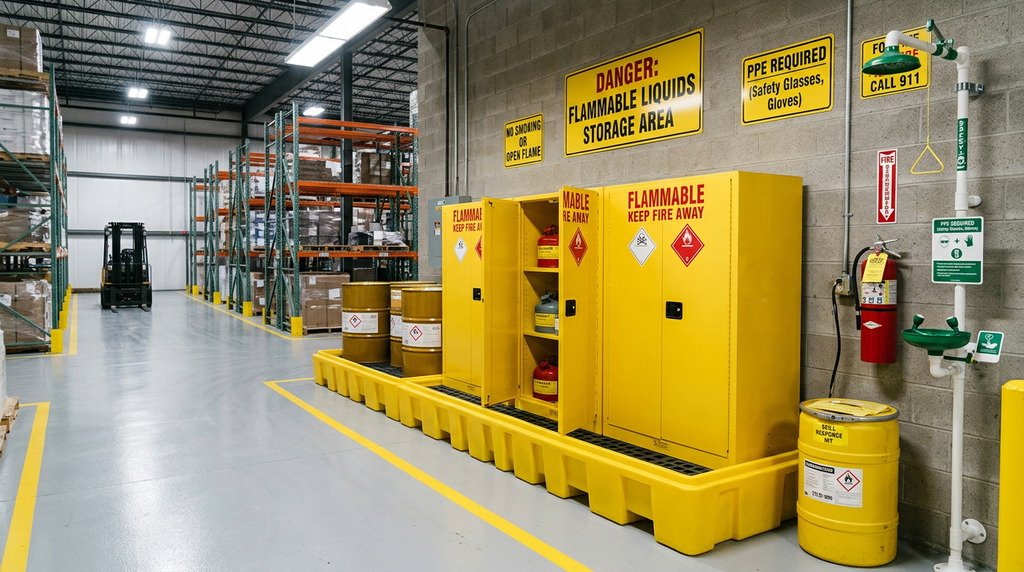
HSG51 is the Health and Safety Executive's guidance on the storage of flammable liquids in containers. If your business stores petrol, diesel, heating oil, solvents, paints, or other flammable liquids, this guidance could be the difference between safe operations and a catastrophic fire or explosion.
Every year, fires involving flammable liquids cause millions of pounds in damage and put lives at risk. Many could be prevented by following HSG51's practical recommendations. Whether you run a garage, manufacturing facility, or simply store fuel for company vehicles, understanding this guidance is essential.
What is HSG51?
HSG51 "Storage of Flammable Liquids in Containers" is Health and Safety Executive guidance that provides practical advice on safely storing flammable liquids in portable containers. Published by the HSE, it covers everything from basic storage principles to detailed technical requirements for different types of facilities.
The guidance applies to flammable liquids stored in containers, drums, intermediate bulk containers (IBCs), and small tanks up to 250 litres capacity. It doesn't cover fixed installations like large fuel storage tanks or underground storage systems, which are covered by separate guidance.
HSG51 supports compliance with several legal requirements, including the Dangerous Substances and Explosive Atmospheres Regulations 2002 (DSEAR), the Health and Safety at Work etc. Act 1974, and relevant fire safety legislation including the Regulatory Reform (Fire Safety) Order 2005.
Who Needs HSG51?
You need to understand HSG51 if your business stores any flammable liquids, including:
- Motor trades — garages storing petrol, diesel, brake fluid, and other automotive chemicals
- Manufacturing facilities — businesses using solvents, adhesives, cleaning agents, or industrial chemicals
- Construction companies — storing fuel for plant equipment and flammable construction materials
- Printing and coating operations — using inks, thinners, and coating materials
- Laboratories — storing reagents, solvents, and other flammable chemicals
- Maintenance facilities — using degreasers, lubricants, and cleaning solvents
- Any business with generators — storing diesel or petrol for backup power
Even small quantities can be dangerous. A few litres of petrol can produce enough vapour to cause a significant explosion if ignited.
What Counts as a Flammable Liquid?
Under HSG51, flammable liquids are those with a flashpoint below 55°C. The flashpoint is the lowest temperature at which a liquid gives off enough vapour to ignite when exposed to an ignition source. Common examples include:
- Petrol (flashpoint around -40°C)
- Diesel (flashpoint around 55°C)
- White spirit (flashpoint around 30°C)
- Acetone (flashpoint -18°C)
- Ethanol (flashpoint 13°C)
- Turpentine (flashpoint 35°C)
If you're unsure whether a substance is flammable, check its Safety Data Sheet (SDS). This legal document must be provided by your supplier and includes hazard classifications and safe handling information. Our guide to understanding Safety Data Sheets explains how to interpret this information.
Legal Framework for Flammable Liquid Storage
HSG51 helps you comply with several overlapping legal requirements:
DSEAR 2002
The Dangerous Substances and Explosive Atmospheres Regulations 2002 require employers to assess risks from dangerous substances, including flammable liquids. You must eliminate or reduce risks so far as is reasonably practicable, provide appropriate equipment and procedures, and ensure adequate information, instruction, and training.
Health and Safety at Work Act 1974
Under Section 2 of HSWA, employers must ensure the health, safety, and welfare of employees so far as is reasonably practicable. This includes providing safe systems of work for handling and storing flammable substances.
Section 3 extends this duty to others who might be affected by your work activities, including visitors, contractors, and members of the public.
Fire Safety Legislation
The Regulatory Reform (Fire Safety) Order 2005 requires duty holders to assess fire risks and take appropriate precautions. Flammable liquid storage is often a significant fire risk that must be addressed in your fire risk assessment.
COSHH Regulations 2002
Many flammable liquids are also hazardous to health and subject to the Control of Substances Hazardous to Health Regulations. You'll need to conduct a COSHH assessment for substances that present health risks as well as fire risks.
Key Principles from HSG51
HSG51 is built around several fundamental safety principles that apply regardless of your specific circumstances:
Minimise Quantities
Store only what you need. Excess quantities increase fire risk and potential damage. Keep working stocks separate from bulk storage, and use a "first in, first out" rotation system to prevent deterioration.
Segregation and Separation
Keep flammable liquids away from ignition sources, incompatible materials, and high-risk areas. This includes separation distances from buildings, boundaries, and other hazards.
Containment
Provide secondary containment to prevent spills reaching drains, watercourses, or spreading to other areas. This might include bunds, drip trays, or dedicated storage cabinets.
Control of Ignition Sources
Identify and control potential ignition sources in storage areas. This includes hot surfaces, electrical equipment, smoking materials, and hot work activities.
Emergency Arrangements
Have appropriate fire-fighting equipment readily available and ensure staff know how to respond to spills, leaks, or fires. This links to your broader fire safety training requirements.
Storage Methods Under HSG51
HSG51 covers several storage methods, each with specific requirements:
Flammable Storage Cabinets
Purpose-built storage cabinets are suitable for smaller quantities. They should:
- Be constructed of steel with appropriate fire resistance
- Have self-closing doors with three-point locking
- Include spillage containment (typically 25% of stored volume)
- Have appropriate ventilation arrangements
- Display clear hazard signs
Separated Storage
For larger quantities, dedicated storage areas may be appropriate. Requirements include:
- Separation distances from buildings and boundaries
- Fire-resistant construction where required
- Adequate ventilation to prevent vapour accumulation
- Impermeable flooring with containment
- Access control to prevent unauthorised entry
External Storage
Outdoor storage can reduce risks to buildings and people but requires:
- Weather protection for containers
- Security measures against theft and vandalism
- Appropriate separation from boundaries and buildings
- Emergency access for fire services
- Environmental protection measures
Practical Implementation of HSG51
Implementing HSG51 recommendations requires a systematic approach:
Risk Assessment
Start with a comprehensive risk assessment covering:
- Types and quantities of flammable liquids stored
- Storage locations and methods
- Potential ignition sources
- People who might be affected
- Environmental considerations
- Emergency response arrangements
This assessment should follow the principles outlined in our guide to the 5 steps to risk assessment.
Storage Planning
Plan your storage layout to:
- Minimise handling and movement
- Provide adequate separation distances
- Allow emergency access
- Facilitate inspection and maintenance
- Consider future expansion needs
Container Selection
Choose appropriate containers that are:
- Suitable for the specific liquid being stored
- Properly labelled with contents and hazard information
- In good condition without damage or corrosion
- Appropriately sized for handling requirements
- Compliant with relevant standards
Housekeeping and Maintenance
Maintain good standards through:
- Regular inspection of containers and storage areas
- Prompt cleanup of spills and leaks
- Proper disposal of waste materials
- Keeping storage areas tidy and well-organised
- Maintaining separation from combustible materials
Training and Competence Requirements
HSG51 emphasises the importance of proper training for anyone handling or storing flammable liquids. Training should cover:
- Hazard recognition — understanding the risks of flammable liquids
- Safe handling procedures — proper techniques for moving and dispensing
- Storage requirements — understanding why controls are necessary
- Emergency procedures — what to do in case of spills, leaks, or fires
- Personal protective equipment — when and how to use PPE
Regular refresher training ensures competence is maintained as circumstances change. Consider integrating this training with your broader workplace safety training programme.
Emergency Planning and Response
Effective emergency planning is crucial when storing flammable liquids. Your emergency procedures should address:
Spill Response
- Immediate actions to contain and control spills
- Elimination of ignition sources
- Evacuation procedures if necessary
- Cleanup methods and disposal arrangements
- Reporting requirements to authorities
Fire Fighting
- Appropriate fire extinguisher types and locations
- When to fight fires and when to evacuate
- Fire service access and water supply arrangements
- Protection of adjacent areas and structures
Remember that different types of flammable liquids may require different fire-fighting approaches. Our guide to fire extinguisher types explains which extinguishers are appropriate for different fire classes.
Record Keeping and Documentation
Maintain appropriate records to demonstrate compliance and support ongoing management:
- Risk assessments — including reviews and updates
- Training records — who was trained, when, and on what
- Inspection records — regular checks of storage areas and equipment
- Incident records — any spills, leaks, or near misses
- Maintenance records — for storage equipment and fire protection systems
These records support your legal compliance and help identify trends or areas for improvement. They're also valuable if enforcement authorities visit your premises.
Common Mistakes and How to Avoid Them
Based on HSG51 and enforcement experience, common problems include:
Inadequate Risk Assessment
Many businesses underestimate the risks or fail to consider all scenarios. Ensure your assessment is comprehensive and considers cumulative effects of multiple substances.
Poor Housekeeping
Allowing combustible materials to accumulate near flammable liquid storage significantly increases fire risk. Maintain clear separation and good housekeeping standards.
Inadequate Training
Staff who don't understand the risks are more likely to cause incidents through unsafe practices. Invest in proper training and regular refreshers.
Ignoring Small Quantities
Even small amounts of highly flammable liquids can cause serious incidents. Don't ignore storage requirements just because quantities seem minimal.
Mixing Incompatible Substances
Some flammable liquids shouldn't be stored together due to chemical incompatibility. Check Safety Data Sheets for specific storage requirements.
Enforcement and Consequences
Failure to properly store flammable liquids can result in serious consequences:
HSE Enforcement
HSE inspectors can issue improvement notices requiring specific actions within set timeframes, or prohibition notices stopping work immediately if there's serious risk. Prosecution is possible for serious breaches, with unlimited fines in the Crown Court.
Fire Authority Action
Fire and Rescue Services can issue enforcement notices under fire safety legislation, requiring improvements to fire precautions or restricting storage quantities.
Environmental Enforcement
The Environment Agency may take action if flammable liquid storage poses environmental risks, particularly regarding spill containment and groundwater protection.
Insurance Implications
Insurers may refuse claims or increase premiums if storage doesn't meet recognised standards. Some policies specifically require compliance with HSG51.
Integration with Other Safety Requirements
HSG51 doesn't exist in isolation. Consider how flammable liquid storage integrates with:
- Fire safety management — including your fire safety policy and emergency procedures
- COSHH compliance — for substances that are both flammable and hazardous to health
- Environmental management — preventing contamination and managing waste
- Security arrangements — preventing theft and unauthorised access
- Workplace transport safety — if moving containers around your site
Staying Current with HSG51
HSG51 is periodically updated to reflect new knowledge, technology, and regulatory changes. Stay current by:
- Checking the HSE website for updated versions
- Reviewing your procedures when circumstances change
- Learning from incidents in your sector
- Engaging with trade associations and professional bodies
- Regular training and competence updates
What to Do Now
If you store flammable liquids, take these steps:
- Get a copy of HSG51 — download it free from the HSE website
- Review your current storage arrangements — against HSG51 recommendations
- Conduct or update your risk assessment — following the 5-step process
- Check staff training needs — ensure everyone handling flammable liquids is competent
- Review emergency procedures — including spill response and fire-fighting arrangements
- Consider professional advice — for complex situations or major storage operations
The cost of implementing HSG51 recommendations is minimal compared to the potential consequences of a fire or explosion. Don't wait for an incident to take action — every day of non-compliance increases your risks.
For ongoing staff awareness, our Fire Safety toolbox talk and Chemical Safety Pack provide ready-to-deliver briefings covering the safe handling and storage of flammable substances.
Need Help with Flammable Liquid Storage?
HSG51 provides comprehensive guidance, but every situation is different. If you're unsure how to apply the guidance to your specific circumstances, or need help conducting risk assessments and implementing controls, get in touch. We can help you understand your obligations and develop practical solutions that keep your people and premises safe.